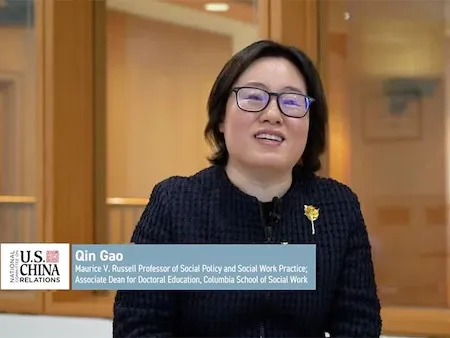
“We need to be able to see the inequality that exists, and then figure out what tools can be used to address those inequalities. If you don’t see it, then you don’t address it.”
That’s AAI acting director Qin Gao, speaking to the National Committee on US–China Relations (NCUSCR) this past February in a feature on challenges that both the United States and China face in combating inequality. Inequality remains pervasive in both countries as government officials grapple with issues like affordability and stagnating employment, with recent shocks to oil markets and the like injecting even more instability into the global economy.
Qin Gao is Maurice V. Russell Professor of Social Policy and Social Work Practice and Associate Dean for Doctoral Education at Columbia’s School of Social Work, as well as Director of the China Center for Social Policy and Acting Director of Columbia’s Asian American Initiative.
In the NCUSCR interview, she describes how social policy scholars in both China and America research what drives inequality in order to propose potential solutions. Two policy tools that have been proven to work, she notes, are early-childhood education and programs that enable women to become entrepreneurs. Professor Gao also holds out hope for collaborative projects between the US and China to study how climate change exacerbates existing inequalities and what actions can be taken to address them.
Professor Gao delivers a cogent rationale for the work she and her peers do. “Social policy research is very powerful because we get to study anything that is directly related to human well-being. It could be housing, it could be education, it could be health care, could be pensions. It could be mental health support. And that’s related to everybody’s well-being, you and me included.”
Later in the Q & A, Professor Gao discusses how she got her start in the social policy field. She credits her grandparents, with whom she grew up, for fostering a sense of social justice and of individual agency. Because her grandfather was a local official, she explains, “I had this impression that social policy, or policies, are made by people—whether it’s local or it’s bigger-scale.”
Watch the video interview below, and listen to a longer audio-only version further below.